
Sub-Floor Drainage and Environmental Control Remediation in Winthrop, IA
Challenge
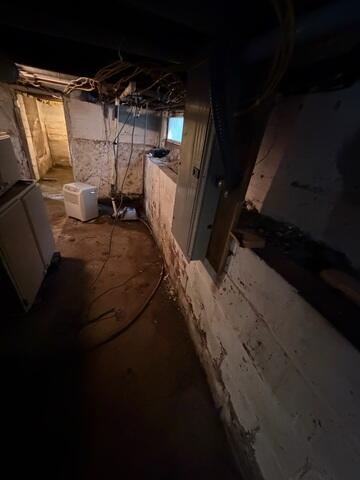
High water tables and poor lateral soil drainage forced groundwater through the cold joint—the vulnerable floor-to-wall juncture—and porous concrete masonry units. This continuous water ingress caused active pooling across the floor slab.
Ambient relative humidity levels consistently exceeded 70 percent within the space. This sustained moisture saturation created an environment optimized for mold sporulation, leading to structural material degradation and strong, musty olfactory signatures.
The property's existing sump pump configuration lacked both the mechanical redundancy and the volumetric pumping capacity required to handle peak hydrostatic surges during heavy midwestern precipitation events, creating a high risk of catastrophic pump failure.
Solution
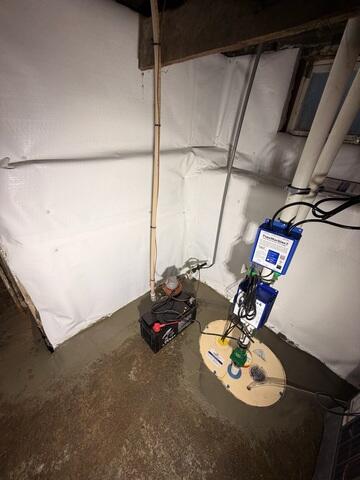
System Design Specialist Shawn Conaway specified the WaterGuard system to address groundwater entry. Foreman Jacob Schultz and his crew, Colby and Jeremiah, breached the concrete floor slab along the perimeter to install this sub-floor, non-clogging drainage conduit. The track sits cleanly above the footing to collect wall and joint seepage without risking soil clog failures.
To ensure uninterrupted water evacuation, the crew integrated the TripleSafe sump pump system into the lowest point of the slab. This station houses a primary 1/3 HP pump for standard duty, a secondary 1/2 HP high-output pump for extreme weather surges, and a battery backup emergency pump to maintain operation during regional power outages.
The production crew mechanically anchored a 20-mil thick, poly-reinforced CleanSpace liner to the foundation walls, sealing the top edge to isolate the home from damp earth walls. They paired this with CleanSpace drainage matting at the base, forcing all wall weeping to funnel directly down behind the liner and straight into the drainage track.
To permanently eliminate ambient humidity and musty aromas, the team deployed a high-efficiency SaniDry Sedona dehumidification unit. This low-temperature system extracts up to 100 pints of water per day and was calibrated to maintain a continuous, sub-50 percent relative humidity matrix, effectively arresting the mold replication cycle.