Mitigating Structural Wall Compromise and Subterranean Moisture Ingress in Orion, IL
Challenge
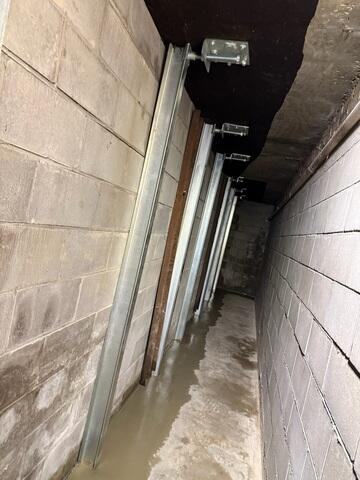
The diagnostic investigation revealed severe vulnerabilities along the subsurface perimeter, where saturated soils exerted intense lateral earth pressures that forced the masonry wall inward past its structural plumb line. Left unmitigated, this deflection threatened the upper-level framing alignment and the home’s primary load-bearing configuration, while hydrostatic pressure forced groundwater directly through the floor-wall cold joint. Continuous capillary action through the porous concrete also drove ambient relative humidity past the threshold for microbial proliferation. To resolve these overlapping failures, the engineering strategy dictated a dual-action approach using low-profile tensile reinforcement bonded directly to the interior masonry face to neutralize soil pressures, paired with an interior sub-floor drainage network to intercept and evacuate groundwater before it could breach the horizontal slab.
Solution
Structural Repair Foreman Jose Ruiz and his technician, Scott, mobilized to execute the mechanical installation within strict structural tolerances. The crew initiated the sequence by performing a mechanical breaching of the concrete floor slab perimeter, excavating a precise trench down to the top of the structural concrete footing. Within this trench, the team installed the WaterGuard® Below-Floor Drain System, utilizing its specialized solid-wall profile directly on top of the footing to isolate it from sediment-clogging mud zones while capturing weeping moisture via an integrated wall-flange extension.
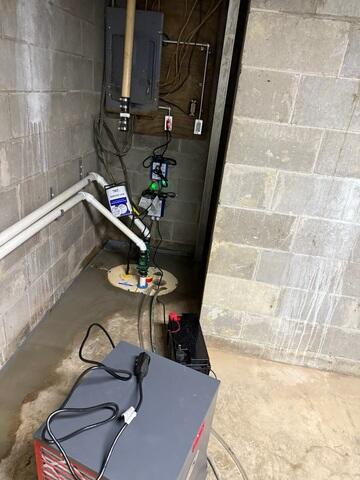
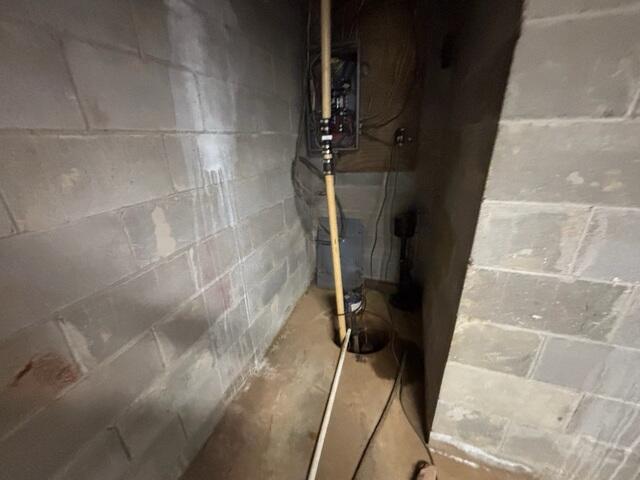
The drainage network was sloped to discharge directly into a high-capacity TripleSafe™ Sump Pump System, establishing absolute operational redundancy via a primary AC pump, a secondary high-output AC pump for peak surge events, and a third DC-powered battery backup pump to sustain dewatering during severe storm-induced grid failures. To stabilize the structural wall failure, Jose and Scott prepared the deflecting foundation surfaces and applied the CarbonArmor® Wall Reinforcement System, using high-strength epoxy resin to bond flexible carbon fiber fabric straps directly to the concrete. Utilizing material ten times stronger than steel in tension, these low-profile straps immediately locked the bowing walls into structural equilibrium and permanently neutralized external lateral soil loads.
To manage latent moisture vapor, the team installed the high-efficiency, commercial-grade SaniDry Sedona™ Dehumidifier, which automatically holds relative humidity levels below 50% to suppress mold spore germination and stabilize the wood moisture content of overhead floor joists. Following a meticulous site cleanup and a flush-pour application of high-strength concrete over the perimeter drain line, the technical intervention by MidAmerica Basement Systems successfully neutralized all subsurface hydraulic and structural vectors, transforming the compromised space into a permanently dry, stable, and secure environment.