
Engineering-Grade Polyurethane Injection and Subgrade Stabilization in Atkins, IA
Challenge
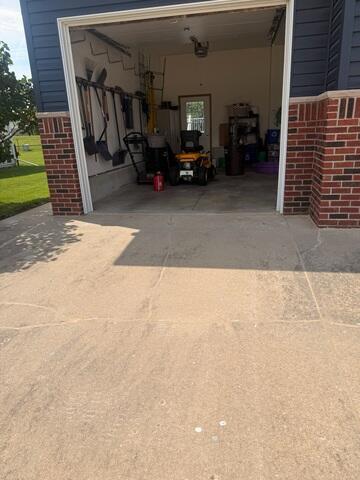
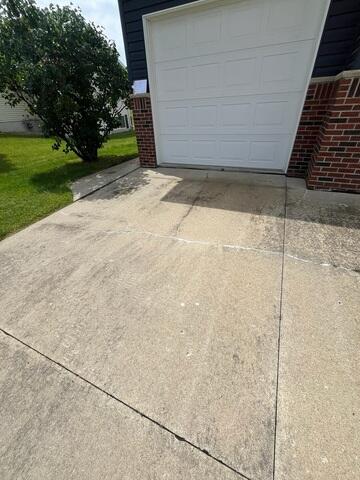
In Atkins, IA, a residential concrete driveway remediation project addressed critical structural failures including differential slab settlement, localized voids, disrupted drainage hydrology, and active pedestrian tripping hazards. The expert engineering team at MidAmerica Basement Systems resolved these issues using high-density polyurethane foam injection via the PolyLevel® system, paired with NexusPro® joint and crack sealant.
A comprehensive structural and geological evaluation of the property revealed significant settlement across multiple contiguous driveway slabs. The primary catalyst for the failure was subgrade compromise caused by poorly compacted fill soils, combined with fluctuating seasonal moisture dynamics typical of eastern Iowa, which led to localized erosion and subgrade consolidation. As moisture infiltrated beneath the pavement joints, fine soil particles migrated outward, creating structural voids directly below the load-bearing concrete plates. This resulted in severe slab junctions exhibiting vertical dislocations measuring up to 1.75 inches, creating distinct physical tripping hazards. Additionally, due to the negative pitch caused by the settlement, surface runoff was directed backward toward the main residence foundation rather than shedding away toward the street, increasing the hydrostatic pressure risks against the home's sub-grade masonry walls.
To avoid the excessive cost, extended curing downtime, and environmental disruption of a full concrete demolition and repour, a multi-stage structural injection and sealing matrix was established. The first phase focused on stabilization and lift, using hydrophobic polyurethane to displace sub-slab moisture, fill underlying voids, compress weak soil zones, and hydraulically lift slabs to their original planar alignment. The second phase utilized an elastomeric protection barrier, employing a silicone and polyurea hybrid to seal operational expansion joints and structural stress cracks against future environmental water ingress.
Solution
The field operations team executed the recovery plan with millimeter precision using a non-destructive deployment sequence. Using specialized hammer drills, a strategic grid of 5/8-inch injection ports was drilled through the settled slabs, preserving the overall structural integrity of the existing concrete matrix. Mechanical injection ports were seated into the slabs, and a closed-cell, high-density polyurethane polymer was injected under pressure. The liquid components underwent an exothermic chemical reaction immediately upon mixing inside the gun, expanding into a rigid, lightweight structural foam. The expanding foam naturally sought out the path of least resistance, filling the uncompacted sub-grade voids first before exerting massive upward hydraulic force to lift the concrete slabs back to their original design elevation. Because the polyurethane formulation is strictly hydrophobic, it completely displaced any trapped sub-slab moisture and will never wash out or degrade under water exposure.
The lift progress was continually monitored to guarantee perfectly planar transitions across all slab intersections. Following successful slab stabilization, the injection ports were patched with a color-matched cementitious grout. The team then prepped the structural cracks and expansion joints by clearing out organic matter and loose debris, subsequently applying the NexusPro® joint sealant. This material exhibits exceptional UV resistance and elasto-plastic elasticity, maintaining an airtight bond during extreme thermal expansion and contraction cycles. The technical deployment achieved all engineering and architectural benchmarks, completely neutralizing all differential tripping hazards and returning the surface to a uniform, safe pedestrian slope. The original outward drainage plane was fully restored, successfully mitigating the risk of foundation water accumulation and associated hydrostatic pressure issues. Finally, the subgrade was thoroughly consolidated by the PolyLevel® polymer matrix, providing a permanent, non-biodegradable foundation that shields the concrete plates from future seasonal freeze-thaw settlement.