Comprehensive Structural Stabilization & Sub-Floor Hydrological Remediation in Coggon, IA
Challenge
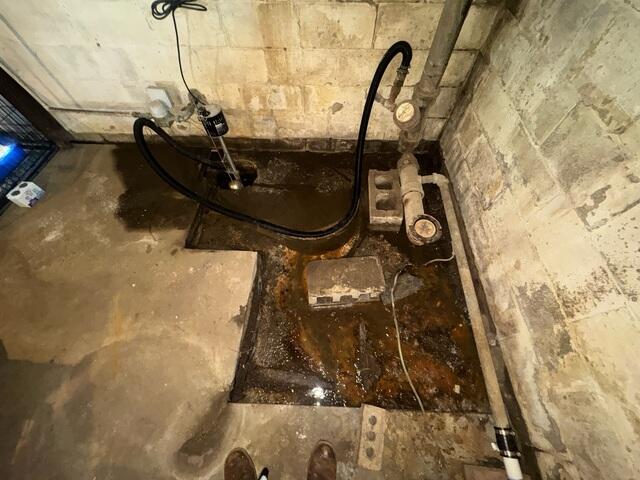
The residential structure in Coggon, Iowa, presented a complex combination of structural failure and severe hydrological duress. Expansive soils surrounding the concrete masonry unit foundation walls had subjected the infrastructure to extreme lateral hydrostatic pressure. This sustained external force resulted in inward wall deflection, horizontal shearing along the frost line, and significantly compromised structural integrity.
Concurrently, high water-table dynamics caused groundwater to breach the footing-wall joint via capillary action and hydrostatic pressure. This resulted in active, continuous weeping across the basement floor and drove ambient relative humidity levels past 75%. This highly saturated environment threatened the upper framing with moisture rot, compromised indoor air quality, and rendered the subterranean square footage entirely unusable for the homeowner's primary objective: the safe, long-term storage of sensitive family heirlooms.
Solution
To resolve these challenges, System Design Specialist Daniel Kelchen engineered a multi-tiered remediation plan executed to precise specifications by Foreman Jacob Oetzman and his production crew—Jose, Antonio, and Colby. To permanently stabilize the failing foundation walls against external soil loads, the crew deployed the GeoLock® Wall Anchor system. Jose and Antonio embedded heavy-duty steel earth plates into stable, undisturbed soil deep outside the foundation. Colby then drove high-tensile steel rods horizontally through the foundation to connect these external plates to heavy-duty interior steel wall plates. Jacob tensioned the entire assembly to exact mechanical specifications, immediately arresting the lateral movement and securing the wall into a configuration that allows for incremental straightening over time.
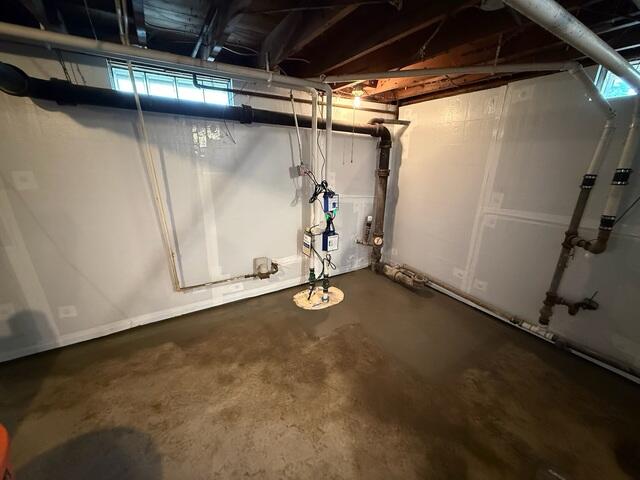
To manage the hydrological influx, the crew breached the perimeter floor slab along the footings to install the WaterGuard® sub-floor drainage conduit. Positioned precisely atop the footing to prevent clogging, this engineered profile intercepts foundational water weeping before it migrates across the slab surface. The perimeter channel was routed directly into a TripleSafe™ Sump Pump Matrix, a redundant system featuring a primary pump for standard volume, a secondary high-volume pump for extreme influx, and an UltraRUSH® battery-backup pump to guarantee uninterrupted operation during total local grid power failure.
To complete the environmental transformation, the crew encapsulated the floor with TerraBlock® insulation, an industrial-grade barrier that breaks the thermal bridge with the cold earth and prevents moisture vapor transmission. Finally, a SaniDry™ Sedona dehumidification system was integrated to actively filter the air down to 2 microns and maintain relative humidity below 50%. The condensed water was gravity-fed directly into the sump matrix, finalizing a fully automated system that transformed a high-liability space into a pristine, climate-controlled storage environment.