Deep-Foundation Stabilization via Helical Geotechnical Piers
Challenge
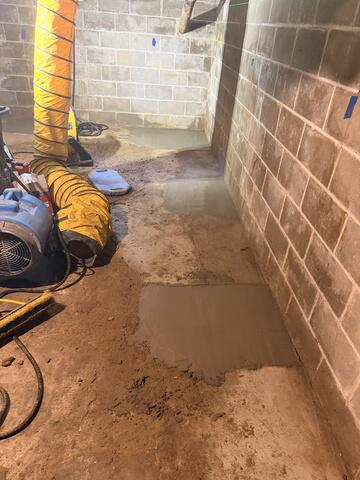
The residential structure in Davenport, IA, presented a classic case of severe differential foundation settlement, threatening both structural integrity and long-term property valuation. Upon initial diagnostic review, the primary root cause was identified as subgrade bearing capacity failure within the shallow soil matrix. Eastern Iowa’s expansive clay topsoils are highly susceptible to volumetric changes driven by seasonal moisture fluctuations. Over time, these unstable soils consolidated and shifted beneath the structural weight, creating localized void spaces beneath the concrete footings.
Lacking continuous, uniform support along the foundation perimeter, the building experienced shear stresses that manifested throughout the living space. The physical symptoms included severe floor slope, diagonal drywall shear cracking at door headers, and binding interior door frames that no longer aligned with their jams. The central technical challenge was arresting this structural downward movement without subjecting the already distressed framing to destructive impact vibrations or relying on heavy equipment that would damage the surrounding residential landscape.
Solution
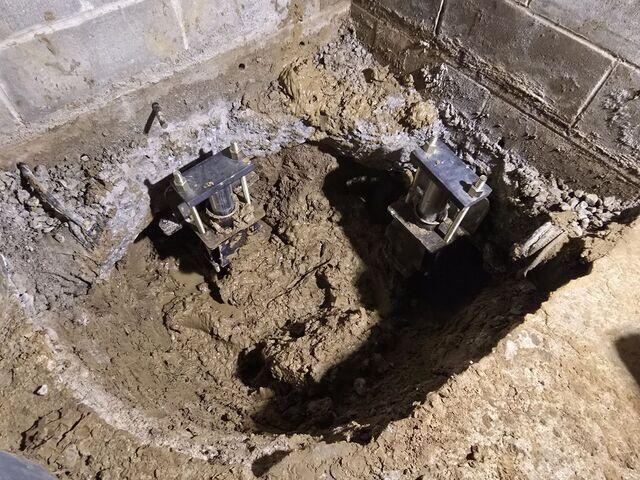
To permanently bypass the compromised, expansive clay layer, System Design Specialist Rob Chismark engineered an advanced deep-foundation support plan utilizing an industrial-grade Helical Pier System. Operations Lead Ian Carnithan alongside field technicians David, Gio, and Markell executed the precision underpinning project by first excavating localized hand-dug access pits to expose the base of the settled footings.
Using high-torque hydraulic drive heads, the crew mechanically advanced heavy-gauge steel shafts fitted with helical flight plates deep into the earth. The team advanced these piers through the weak, uncompacted topsoil until the continuous torque readings confirmed that the flight plates had anchored into dense, load-bearing glacial till far below the active frost and moisture line. Heavy-duty steel foundation lifting brackets were then fitted beneath the concrete footings and connected to a manifold hydraulic jack system. By applying synchronized upward pressure, the team transferred the structural weight off the failing topsoil and locked it onto the deep steel piers, stabilizing the house and lifting the foundation back toward its original level position. The access pits were then backfilled and compacted, leaving behind a concealed, fully warrantied underpinning matrix that permanently secures the home's structural future.