
Polymer Encapsulation & Environmental Microclimate Management for Below-Grade Crawl Spaces
Challenge
A sub-grade residential crawl space foundation in Iowa City, IA, developed severe environmental microclimate deterioration characterized by elevated relative humidity, organic mold proliferation, and unmanaged hydrostatic vapor transmission. Diagnostic Engineer Tim Rollet conducted a technical site assessment and determined that unsealed soil substrates paired with passive structural wall venting allowed continuous ambient vapor infiltration and capillary moisture rise from underlying native soils.
The unencapsulated earth floor acted as an unrestricted moisture reservoir, evaporating water vapor directly into the enclosed subterranean volume. Natural thermal buoyancy (the "stack effect") pulled this warm, moisture-laden air upward into the primary living envelope, elevating interior relative humidity levels above 70%—a critical threshold for wood decay fungi, microbial growth, and structural subfloor timber degradation. The primary engineering challenge required fully isolating the sub-grade envelope from soil gas and ground moisture, establishing a sub-membrane drainage path for subterranean water surges, and mechanically conditioning the subterranean air volume to achieve permanent relative humidity suppression.
Solution
To isolate the structural envelope and achieve complete environmental stabilization, Diagnostic Engineer Tim Rollet engineered a three-tier subterranean encapsulation and moisture control protocol incorporating CleanSpace® Vapor Barrier, CleanSpace® Drainage Matting, and the SaniDry™ Sedona Dehumidifier. Operations Lead Justin Maddox and field technician Devin S. executed the specialized environmental remediation.
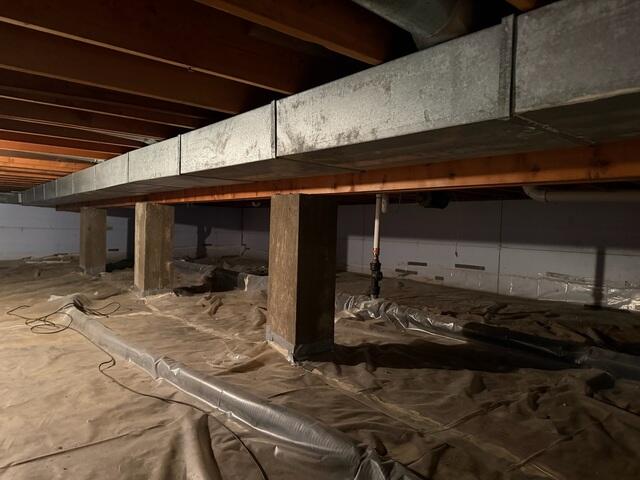
Phase one involved sub-membrane hydro-management. Justin and Devin S. installed dimpled, high-density polyethylene CleanSpace Drainage Matting directly across the exposed earth floor. The engineered raised-profile matting created a continuous sub-floor void space, allowing any pooling hydrostatic water beneath the membrane to drain uninhibited toward the perimeter discharge network without building head pressure against the liner.
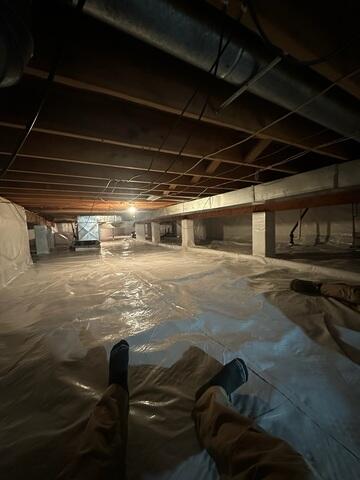
Phase two established total envelope isolation. The crew installed a 20-mil thick, multi-layer poly-reinforced CleanSpace vapor barrier over the drainage matting and up the interior foundation walls to the sill plate. The inorganic membrane was mechanically fastened to the masonry walls using non-corrosive anchors and sealed at all seams and mechanical penetrations with specialized butyl tape, creating a monolithic, gas-impermeable barrier that prevents moisture vapor and soil gas transmission.
Phase three implemented active environmental conditioning. The team sealed all exterior crawl space vents to cut off ambient outdoor humidity and installed a high-efficiency SaniDry Sedona dehumidification system. Delivering a 285 CFM airflow capacity, the unit continuously circulates and conditions the sub-grade air volume, extracting up to 95 pints of water per day while filtering airborne particulates down to 3 microns via an integrated MERV 8 media filter. The automated mechanical system locks relative humidity safely below 50%, eliminating microbial growth risks and ensuring long-term structural integrity for the entire home.