
Geopolymer Concrete Lifting and Structural Joint Sealing in De Witt, IA
Challenge
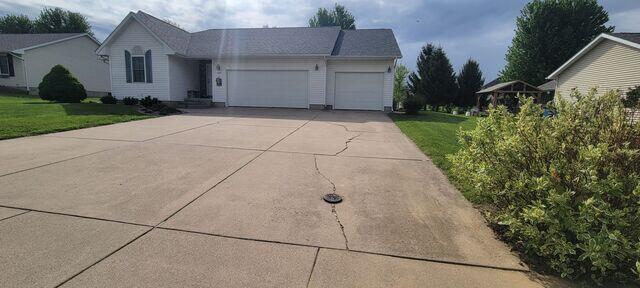
A residential concrete driveway in De Witt, IA, exhibited severe differential settlement, extensive longitudinal cracking, and advanced moisture infiltration. Over time, seasonal freeze-thaw cycles combined with poor sub-base compaction had caused the underlying soils to erode. This left subsurface voids that could no longer support the massive dead load of the concrete slabs. As a result, multiple segments of the driveway sank unevenly, creating severe vertical offsets (trip hazards) and misaligning the drainage planes.
Left unaddressed, the open cracks and sunken joints acted as funnels, directing runoff water straight into the sub-grade. This continuous water intrusion threatened to accelerate sub-base washout and promoted localized mold and organic growth along the fractures. The homeowner required a solution that would stabilize the sub-grade, realign the slabs to restore proper water shedding, and seal the entire system against future moisture intrusion—all without the disruption, cost, and high carbon footprint of a complete driveway replacement.
System Design Specialist Andrew Sagar performed an extensive mechanical evaluation of the driveway. He determined that the slabs were structurally intact enough to be preserved, and engineered a remediation plan utilizing high-density geopolymer injection paired with a commercial-grade silicone joint seal.
Solution
To resolve the structural and moisture challenges permanently, the production team deployed a rapid-curing, minimally invasive concrete restoration system. Foreman Chris Allen and crew member Markell began the process by cleaning the surface and mapping out a strategic grid of 5/8-inch injection ports across the depressed concrete segments.
Through these micro-ports, the crew injected PolyLevel Concrete Leveling Solutions. PolyLevel is a two-part, high-density structural polyurethane geopolymer. Upon entering the subterranean voids, the components undergo an exothermic chemical reaction, expanding rapidly to densify the loose sub-base soils and fill all empty cavities. As the foam expanded, it exerted a controlled, uniform upward force, allowing Chris and Markell to precisely lift the heavy slabs back to a completely flush, level position. This light weight of the cured polyurethane (approximately 2 to 4 pounds per cubic foot) ensures that it does not impose additional loading stresses on the fragile sub-grade, unlike traditional mudjacking slurries.
Once the driveway slabs were perfectly leveled and the drainage planes restored, the crew addressed the moisture vulnerability. They routed, cleared, and thoroughly prepared all fractured joints and open cracks to accept NexusPro Cracked Concrete Repair. This premium, silicone-based joint sealant was professionally tooled into the gaps over a closed-cell backer rod. NexusPro is specifically engineered to maintain its elasticity across extreme temperature deltas and resists UV degradation without cracking, bubbling, or drying out.
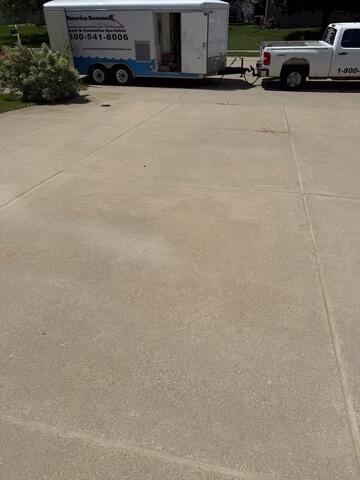
To ensure an optimal aesthetic finish, Chris and Markell dressed the fresh sealant with native sand, blending the repaired joints seamlessly into the original texture of the concrete. By sealing these entry points, the team created an impermeable barrier that prevents surface water from reaching the sub-grade. Thanks to Andrew's precise engineering design and the expert execution by Chris and Markell, the structural integrity of the driveway was completely restored, the trip hazards were eliminated, and the entire system is now protected against future soil washout and mold growth.