
Precision Concrete Lifting & Void Mitigation via High-Density Polyurethane Injection
Challenge
The project presented a multi-layered asset management problem. Left unaddressed, the shifting concrete posed immediate safety and long-term structural liabilities:
-
Sub-Base Failure & Void Formation: Granular soils beneath the primary driveway slabs had undergone localized compaction and erosion due to historical water infiltration, leaving significant subsurface voids unable to support the weight of the concrete.
-
Stress Concentrations & Structural Risk: The loss of uniform sub-grade support subjected the unreinforced concrete to severe bending stresses, manifesting in early-stage structural cracking and risking complete slab failure under vehicular loads.
-
Hydrological Hazards: Sunk slabs altered the original drainage profile, creating a pooling effect. This negative pitch funneled stormwater runoff directly toward the residential foundation, creating risks for accelerated foundation erosion and aggressive frost-heaving cycles during winter months.
-
Conventional Limitations: A traditional rip-and-replace approach was ruled out due to prohibitive costs, extensive curing downtime (blocking driveway access for days), and excessive environmental waste.
Solution
To address these challenges, our System Design Specialist, Rob Chismark, engineered a targeted restoration plan utilizing the advanced PolyLevel® system. The project was handed over to our elite production team, led by Foreman Justin Maddox and crew member Devin S., who executed a precise, three-step technical solution:
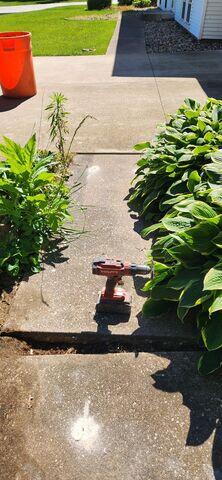
Justin and Devin mapped out a customized injection grid across the settled slabs. Using specialized equipment, they drilled ultra-discreet, 5/8-inch injection ports (pea-sized holes). This minimized the aesthetic impact on the driveway and preserved the overarching matrix of the concrete.
Using automated plural-component proportioning equipment, the team metered the injection of PolyLevel®: a hydro-insensitive, high-density polyurethane foam. As the components chemically reacted beneath the surface, they expanded volumetrically, migrating into the micro-voids of the sub-base and compacting the loose subgrade soils.
Devin continuously monitored the slab levels with precision laser measurement tools. The expanding foam exerted upward hydrostatic pressure, allowing Justin to accurately lift and realign the heavy concrete slabs to within millimeters of their original design elevation.
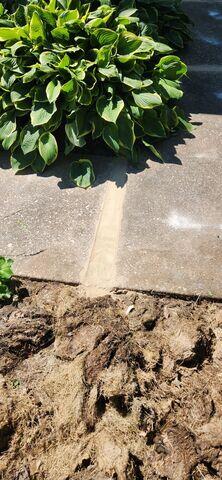
Once structural equilibrium and optimal pitch were achieved, the injection ports were mechanically sealed with an industrial-grade, color-matched cement grout mix, rendering the repair virtually invisible.