
Geotechnical Void-Fill and Structural Polyurethane Slab Jacking in Geneseo, IL
Challenge
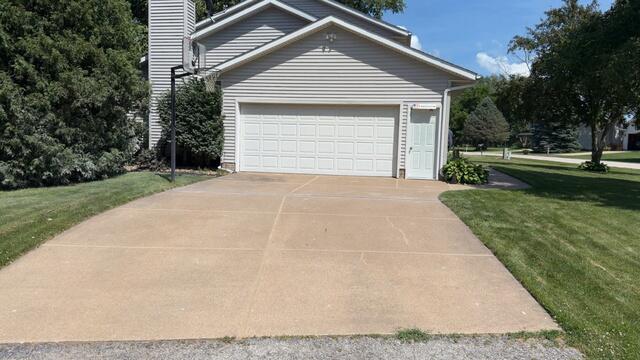
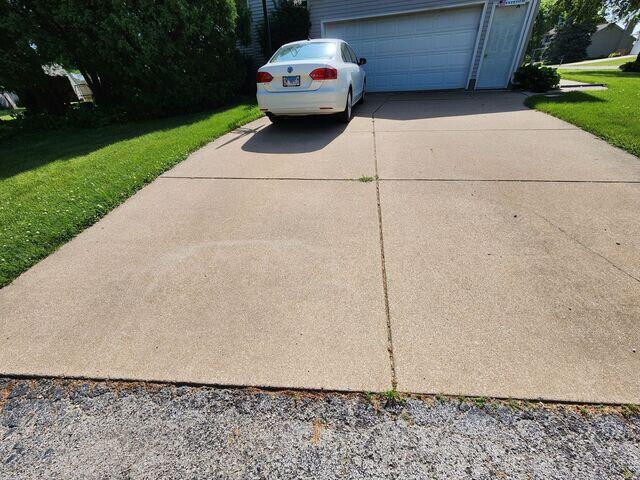
The primary structural deficit occurred within a three-panel section of the exterior driveway slab, which had undergone a differential settlement drop of nearly two and a half inches relative to the adjacent pavement. Geotechnical evaluation indicated that the failure was rooted in a substantial subgrade void. This subsurface cavity was caused by localized hydraulic erosion, as unchanneled roof runoff had infiltrated the unsealed control joints and washed out the finely graded bedding sand beneath the concrete.
Deprived of uniform subgrade support, the unreinforced concrete panels functioned as point-loaded beams, experiencing high tensile stress that caused structural cracking and a steep, dangerous slope. Left unmitigated, continued soil migration threatened to cause total mechanical failure of the driveway approach, while allowing heavy rainwater to pool directly against the home's foundation wall.
Solution
To restore the load-bearing capacity of the subgrade without the high capital costs and carbon footprint of a complete demolition and reconstruction, the production team executed a precise PolyLevel® polyurethane injection sequence. The crew mapped the settlement profile and drilled a strategic grid of 5/8-inch injection ports through the concrete panels to access the subterranean void.
A high-density, two-component closed-cell hydrophobic polyurethane geopolymer was then metered into the ports under high pressure. Upon entry into the subgrade, the liquid components underwent an exothermic chemical reaction, expanding rapidly into a dense, structural foam that filled 100 percent of the hidden void space. This expansion compacted the surrounding loose soils, increasing the overall subgrade modulus, and exerted a powerful, uniform upward pneumatic force of up to several thousand pounds per square foot.
Using precision optical lasers, the team monitored the lift down to the millimeter, halting the chemical injection the exact moment the sunken panels achieved a perfectly flat, flush alignment with the surrounding driveway sections.
To permanently protect the restored subgrade from future hydraulic failure, the crew mechanically routed all intersecting control joints and cracks. They then installed NexusPro® joint sealant, a premium, medical-grade silicone-based elastomeric compound. Unlike standard polyurethane caulking, this advanced formulation maintains high elasticity under extreme Midwestern thermal contraction and expansion cycles and provides superior UV resistance. This dual-phase remediation completely stabilized the concrete pavement foundation, eliminated the water-pooling hazard, and sealed the system against future moisture-driven erosion.