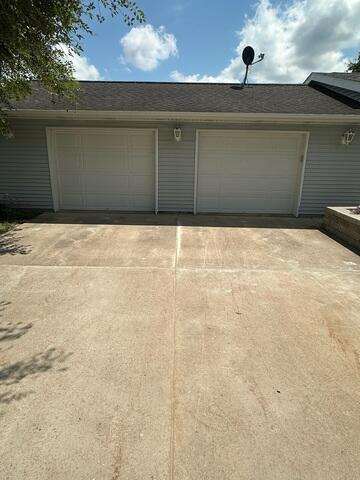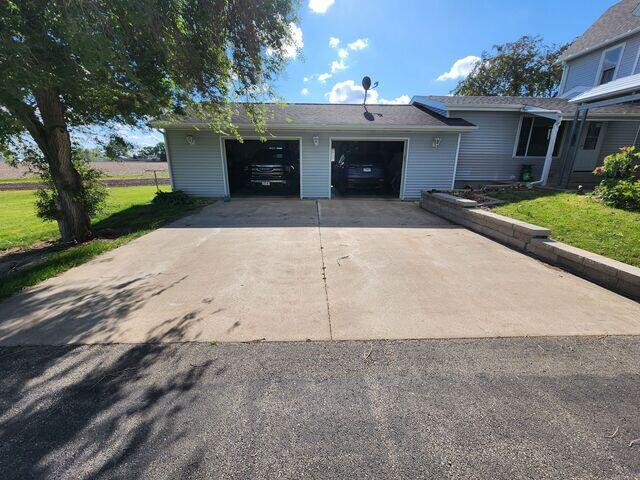

High-Density Polymer Injection & Flexible Elastomeric Joint Sealing for Residential Driveway Slab Restoration
Challenge
A concrete driveway installation in Bradford, IL, exhibited significant differential slab settlement across primary expansion joints, creating hazardous tripping points and impeding vehicle transit. The primary failure mechanism was identified as hydraulic subgrade washout beneath the load-bearing concrete matrix. Unsealed control joints and surface fractures permitted uninhibited surface water runoff to penetrate the subbase, systematically eroding fine-grained soil particles directly beneath the flatwork.
As the supporting subgrade washed away, localized subterranean void spaces formed beneath the driveway. Lacking continuous, uniform base support, unsupported concrete sections sheared along weakness lines and settled under their own weight and vehicular loads. The core technical challenge was filling these sub-slab voids and precisely raising the heavy concrete back to a level, stable plane without applying heavy material weight that could induce secondary soil settlement, and without resorting to noisy, high-impact slab demolition.
Solution
To restore structural slab elevation without requiring invasive replacement or adding heavy static loads, System Design Specialist Rob Chismark engineered a multi-stage lifting and hydro-sealing protocol using PolyLevel® Concrete Leveling and NexusPro® Joint Sealant. Operations Lead Justin Maddox and field technician Devin S. initiated the repair by drilling dime-sized injection ports through the settled slabs at strategically calculated structural lift points.
Using specialized high-pressure injection equipment, the crew pumped a high-density, hydrophobic two-part polyurethane foam beneath the concrete matrix. Upon injection, the expanding geopolymer filled all subgrade voids, compacted weak surrounding subbase soils, and exerted upward hydraulic force to raise the settled slabs flush with adjacent surfaces. Following precision elevation alignment, the team cleared all open joints of debris and applied UV-resistant NexusPro silicone joint sealant along every seam, creating a flexible, water-tight barrier against seasonal thermal expansion and future water infiltration. The injection ports were patched with matching cementitious grout, leaving the driveway fully stabilized, protected against future soil washout, and immediately ready for vehicular traffic.