
Polymer Geopolymer Void Filling & Subgrade Stabilization for Differential Concrete Slab Settlement
Challenge
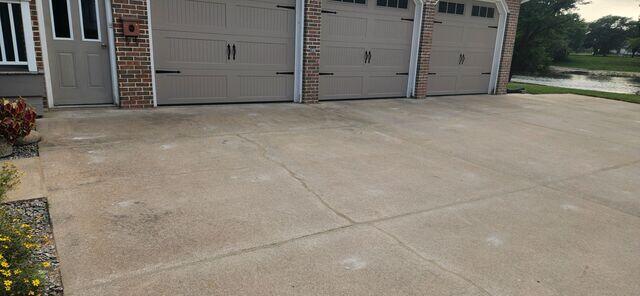
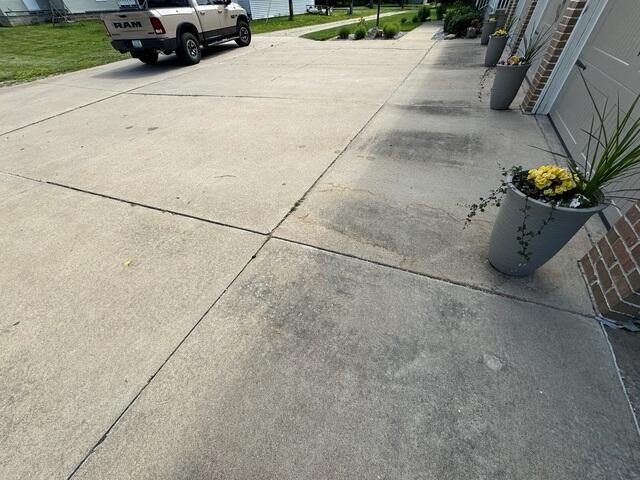
A residential exterior concrete flatwork installation in Waverly, IA, exhibited severe differential settlement resulting in localized vertical displacement across control joint interfaces. Diagnostic Engineer Tim Rollet conducted an structural flatwork assessment, identifying a combination of subgrade soil consolidation, seasonal freeze-thaw degradation, and water-induced piping erosion as the primary mechanisms of failure.
Infiltration of surface runoff through unsealed control joints washed fine-grained soil particulates out from the underlying aggregate base layer, creating subterranean void spaces beneath adjacent slabs. Deprived of uniform continuous support, individual slabs experienced independent movement under transient loads, producing vertical lip offsets along the expansion joints. These raised slab edges created severe trip hazards and structural interference during mechanical snow clearance operations, where snowblower and shovel blades exerted high impact forces on the exposed vertical slab faces. The engineering objective required filling subterranean void networks, compacting low-density subgrade soils, and restoring coplanar alignment between adjacent slabs without imposing high static dead loads or relying on destructive slab replacement.
Solution
To rectify the vertical misalignment and eliminate subterranean void conditions, Diagnostic Engineer Tim Rollet engineered a high-density geopolymer lifting and surface joint remediation protocol utilizing PolyLevel® Concrete Leveling and NexusPro® Joint Sealant. Operations Lead Justin Maddox and field technician Devin S. executed the precision structural alignment.
Phase one involved geopolymer injection and dynamic hydraulic lifting. The crew drilled a matrix of micro-injection ports (5/8-inch diameter) at calculated structural lift points along the depressed slab geometry. Using specialized high-pressure metering equipment, the team injected a two-part closed-cell hydrophobic polyurethane resin into the subgrade. Upon chemical reaction, the expanding polymer occupied subterranean air voids, aggressively densified surrounding weak subgrade soils, and generated controlled upward expansion pressure. The expansion force elevated the settled slab until its upper plane achieved exact coplanar alignment with adjoining surfaces.
Phase two established permanent moisture barrier protection. Once the geopolymer cured to full compressive strength, the crew prepped all control joints, cracks, and injection port penetrations, removing residual debris to ensure maximum bond adhesion. The team then installed NexusPro elastomeric silicone joint sealant along all exposed seams. Formulated to withstand extreme UV exposure, broad thermal expansion cycles, and chemical exposure, the flexible sealant created an impermeable barrier against surface water infiltration, preventing future subgrade erosion and securing long-term slab elevation stability.