
Subgrade Void Consolidation and Precision Pedestrian Entry Realignment in Marion, IA
Challenge
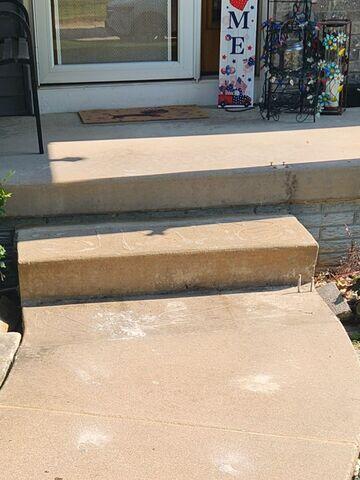
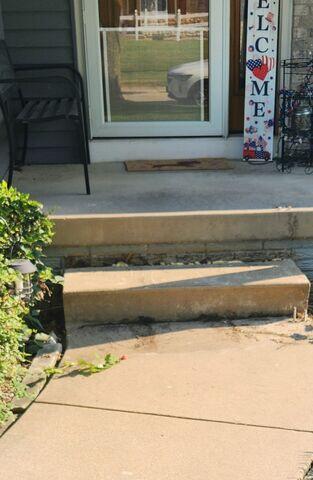
The structural failure occurred across a multi-tier cast-in-place concrete entry step assembly that served as the primary access point to the residence. Over several seasonal cycles, unsealed control joints allowed concentrated roof runoff and snowmelt to penetrate the subgrade directly adjacent to the foundation wall. This water infiltration caused significant hydraulic piping, washing away the underlying fine-aggregate bedding material and leaving a subterranean void beneath the base slab.
Deprived of uniform subgrade support, the heavy concrete step unit underwent a multi-axis rotational drop, resulting in a vertical offset of over one and a half inches relative to the adjacent porch landing. This structural displacement created an uneven riser height that violated standard building codes, creating a dangerous trip hazard for foot traffic that was further amplified during winter freeze-thaw cycles. Left unmitigated, continued void growth threatened to cause full structural shearing of the unreinforced steps.
Solution
To stabilize the subgrade and realign the steps without the destructive excavation and costly downtime of a complete tear-out, the production team utilized an engineered closed-cell geopolymer injection workflow. The crew began by mapping the void geometry beneath the slab and drilling a strategic grid of micro-injection ports, measuring just 5/8 of an inch, through the concrete surface.
The team then introduced the PolyLevel® geopolymer system through the ports under regulated pressure. As the two-part high-density polyurethane liquid reacted beneath the steps, it underwent rapid exothermic expansion, filling 100 percent of the subterranean void space and consolidating the loose surrounding soil matrix. The expanding foam exerted a controlled, uniform upward force, allowing the crew to precision-lift the steps back to their original horizontal plane with millimeter accuracy.
To permanently protect the restored subgrade against future hydraulic erosion, the crew mechanically cleaned the joint interfaces and applied NexusPro® joint sealant. This advanced, single-component silicone elastomeric compound provides high-movement capability, superior resistance to solar UV degradation, and a complete watertight seal across extreme thermal contraction and expansion cycles. The dual-action repair fully re-established subgrade load-bearing capacity, eliminated the dangerous entry hazard, and sealed the structural assembly against future moisture intrusion.