
Geotechnical Subgrade Consolidation and Accessibility Restoration in Bettendorf, IA
Challenge
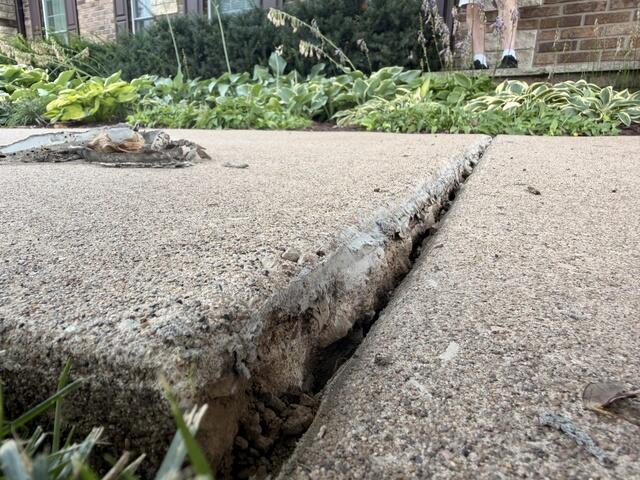
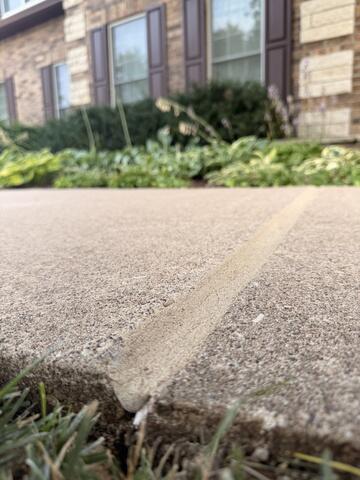
The structural deficiency occurred along a multi-panel section of the primary residential entry walkway. Subsurface evaluation indicated that differential settlement had created a severe vertical lip between adjacent panels. This failure was driven by localized hydraulic erosion within the shallow subgrade. Inadequate surface runoff management, combined with unsealed control joints, allowed seasonal rainwater and snowmelt to infiltrate the bedding sand beneath the concrete.
Over time, this moisture migration created subterranean voids and compromised the load-bearing capacity of the native subgrade soil. Deprived of uniform support, the unreinforced concrete panels underwent rotational settlement, creating a high-profile trip hazard. For an aging resident, this structural displacement presented an unacceptable physical safety risk that was compounded during winter icing conditions.
Solution
To restore the walkway's structural plane and eliminate the trip hazard without the high cost, prolonged downtime, and site disruption of full concrete replacement, the team implemented a dual-phase geopolymer stabilization and joint-sealing process.
First, for subgrade void filling and pneumatic lifting, the crew established a targeted injection grid and drilled discrete ports through the concrete surface. High-density, two-part hydrophobic PolyLevel® polyurethane foam was injected beneath the slab under controlled pressure. Upon contact within the subgrade, the geopolymer underwent an exothermic reaction, expanding rapidly to fill the entirety of the subterranean void space. The expanding foam densified the surrounding loose soils and exerted a precise upward pressure, re-establishing continuous subgrade contact and raising the panels back to a flush, level alignment.
Second, for waterproofing and joint encapsulation, the team mechanically prepped all control joints and stress cracks to prevent future hydraulic piping and subgrade washout. The openings were sealed with NexusPro® joint sealant, a highly flexible, silicone-based elastomeric compound. Unlike traditional polyurethane caulks, NexusPro retains its elasticity during extreme thermal contraction and expansion cycles, resists UV degradation, and forms an impermeable barrier against surface water.
This targeted remediation restored the structural integrity of the subgrade, permanently eliminated the safety hazard, and provided a durable, maintenance-free pedestrian surface designed to withstand regional weather fluctuations.