
Subsurface Void Remediation and Driveway Slab Elevation in Eldridge, IA
Challenge
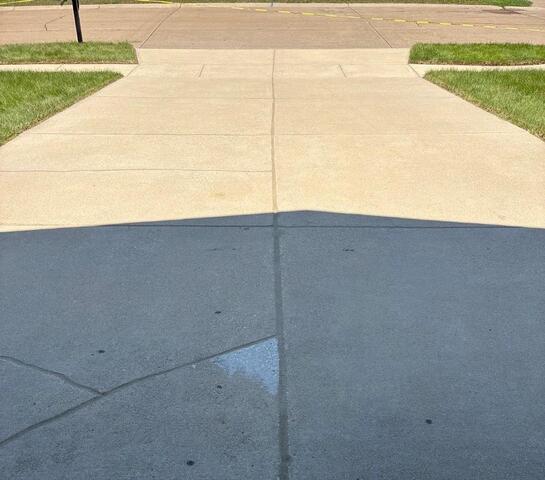
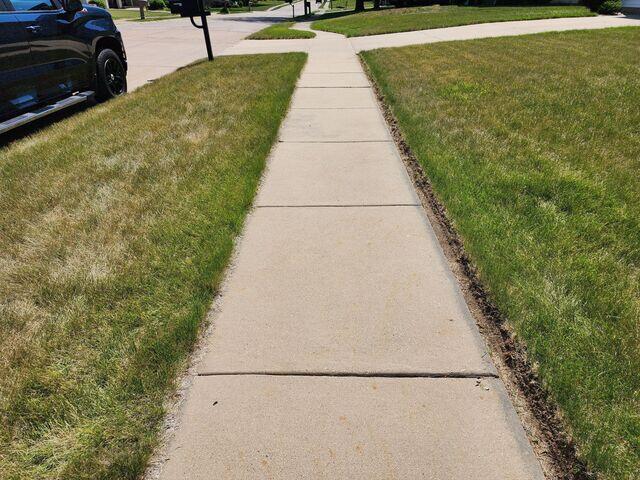
Subgrade failure across the main residential driveway created distinct vertical steps between adjacent concrete panels, threatening structural integrity under vehicular loads and presenting an immediate impact hazard for foot traffic. Environmental analysis revealed that subsurface soil erosion was the primary catalyst. Surface water infiltration through unsealed control joints and lateral perimeter fissures washed away the underlying bedding materials. This continuous hydrologic action created subterranean voids, compromising the subgrade bearing capacity. Lacking continuous support, the heavy unreinforced slabs underwent uneven rotational settlement.
Solution
To stabilize the subgrade and raise the driveway to a flush, level plane without high-cost slab demolition and repouring, the field crew executed a dual-stage geopolymer injection and surface sealing protocol.
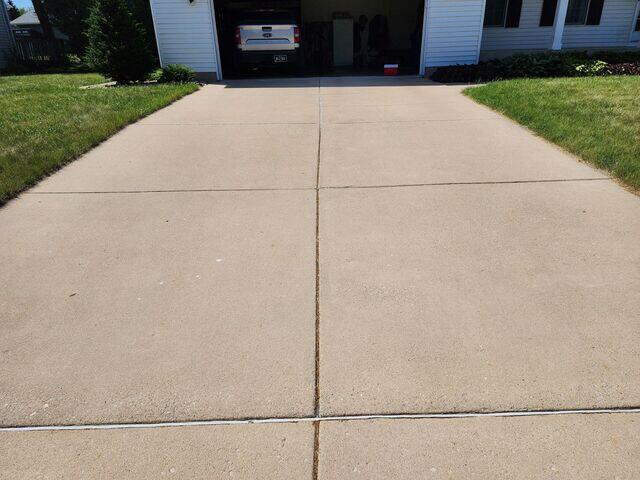
First, for subgrade consolidation and hydraulic lifting, the team established a calculated injection grid and drilled discrete ports through the sunken concrete panels. High-density, closed-cell hydrophobic PolyLevel® polyurethane foam was injected directly into the void spaces beneath the driveway. The liquid components underwent an exothermic reaction, expanding rapidly to fill subgrade voids and compact surrounding weak soil. As the material reached maximum expansion force, it exerted continuous upward pneumatic pressure, gently elevating the heavy driveway panels back into flush alignment with adjacent slabs.
Second, for surface waterproofing and joint encapsulation, the crew prepped and cleared all structural cracks and expansion joints. The crew then applied NexusPro® joint sealant, an advanced silicone-based elastomeric sealant engineered to form a permanent moisture barrier. Unlike traditional polyurethane caulk, NexusPro maintains elasticity during extreme thermal expansion and contraction, resists intense UV degradation, and prevents future surface runoff from penetrating the subgrade.
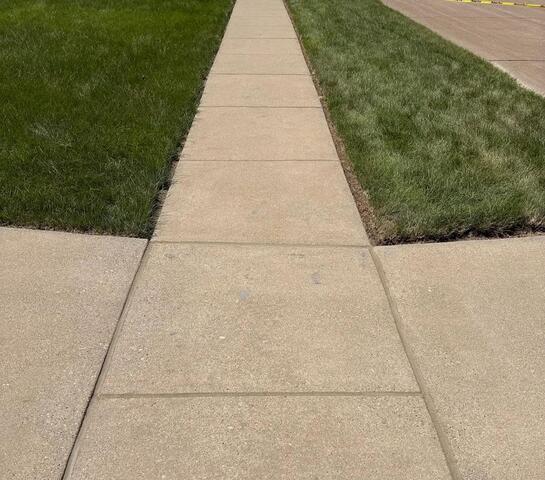
This targeted remediation restored uniform subgrade support, eliminated vehicular and pedestrian hazards, and created an impermeable barrier against future soil washout.